First- & Second-Author Papers
Ravi, Swati; Ng, Mason; Marshall, Herman; Gnarini, Andrea “What’s the Buzz about GX 13+1? Constraining Coronal Geometry with QUEEN-BEE: A Bayesian Nested Sampling Framework for X-Ray Polarization Rotation Analysis” ApJ, 2026. DOI: 10.3847/1538-4357/ae21bd
Gunderson, Sean; Ravi, Swati; et al. “X-Ray Polarimetry of Accreting White Dwarfs: A Case Study of EX Hydrae” ApJ, 2025. DOI: 10.3847/1538-4357/ae11b5
Co-Author Papers
Mikušincová, Romana, et al. (41 co-authors including Swati Ravi) “The First X-Ray Polarimetry of an Eclipsing Low-Mass X-Ray Binary: Serendipitous IXPE Observation of AX J1745.6-2901” Submitted, 2025. arXiv: 2512.13182
Details
Kashyap, Unnati, et al. (8 co-authors including Swati Ravi) “First X-Ray and Radio Polarimetry of the Neutron Star Low-mass X-Ray Binary GX 17+2” ApJ, 2025. DOI: 10.3847/1538-4357/ae12f3
Details
First observation of Neutron Star-Low-Mass X-ray Binary GX 13+1 with Imaging X-Ray Polarimetry Explorer (IXPE) space telescope reveals an X-ray polarization degree of ~2%, while the source was in the normal branch, with consistent PA alignment between X-ray and radio polarization measurements. I conducted polarization PCUBE analysis and spectropolarimetric analysis of IXPE data for this paper.
Marra, Lorenzo, et al. (36 co-authors including Swati Ravi) “Exploring MAXI J1744-294: IXPE insights into a Newly Discovered X-ray Transient” Submitted, 2025. arXiv: 2506.17050
Details
Kashyap, Unnati, et al. (6 co-authors including Swati Ravi) “X-Ray and Radio Polarimetry of the Neutron Star Low-mass X-Ray Binary GX 13+1” ApJ, 2025. DOI: 10.3847/1538-4357/adf968
Details
Observation of Neutron Star-Low-Mass X-ray Binary GX 13+1 with Imaging X-Ray Polarimetry Explorer (IXPE) space telescope reveals an X-ray polarization degree of ~1.4%, with a misaligned radio polarization signal (offset by ~45°). This suggests a geometry comprising of a softer accretion disk component with a harder blackbody component arising from a boundary or spreading layer. I conducted polarization PCUBE analysis and spectropolarimetric analysis of IXPE data for this paper.
Kashyap, Unnati, et al. (7 co-authors including Swati Ravi) “X-Ray and Radio Polarimetry of the Neutron Star Low-mass X-Ray Binary 4U 1728–34” ApJ, 2025. DOI: 10.3847/1538-4357/adceb9
Details
Observation of Neutron Star-Low-Mass X-ray Binary 4U 1728-34 with Imaging X-Ray Polarimetry Explorer (IXPE) space telescope reveals an X-ray polarization degree of ~2%, with no significant polarization in the radio band. This suggests the presence of a Comptonized component of the Neutron star geometry such as a boundary layer. I conducted polarization PCUBE analysis and spectropolarimetric analysis of IXPE data for this paper.
Kashyap, Unnati, et al. (6 co-authors including Swati Ravi) “X-ray polarization study of the neutron star low-mass X-ray binary GX 349+2” ApJ, 2025. DOI: 10.3847/1538-4357/adda35
Details
Observation of Neutron Star-Low-Mass X-ray Binary GX 349+2 with Imaging X-Ray Polarimetry Explorer (IXPE) space telescope reveals a polarization degree of ~1%. This paper reports the first IXPE observation of the source. I conducted polarization PCUBE analysis and spectropolarimetric analysis of IXPE data for this paper.
Tarana, Antonella, et al. (17 co-authors including Swati Ravi) “X-ray spectro-polarimetry analysis of the weakly magnetized neutron star X-ray binary GX 9+1” A&A, 2025. DOI: 10.1051/0004-6361/202554083
Details
Loktev, Vladislav, et al. (15 co-authors including Swati Ravi) “Exploring polarization and geometry in the X-ray pulsar 4U 1538‑52” A&A, 2025. DOI: 10.1051/0004-6361/202554151
Details
Observation of X-ray Pulsar 4U 1538‑52 with Imaging X-Ray Polarimetry Explorer (IXPE) space telescope reveals a marginal polarization detection of ~3% and potential evidence of energy-dependent polarization, providing constraints on measurements of magnetic obliquity (~30°) and spin position angle (~19°) of the source. This paper reports the first IXPE observation of the source. I conducted polarization PCUBE analysis and spectropolarimetric analysis of IXPE data for this paper and supervised spectropolarimetric analysis conducted by R. Kelly.
Kelly, Ruth, et al. (8 co-authors including Swati Ravi) “Exploring the Future of Soft X-ray Polarimetry: the Capabilities of the REDSoX Instrument for XDINS and Magnetar Studies” ApJ, 2025. DOI: 10.3847/1538-4357/adde58
Details
Simulations of the X-ray spectropolarimetric properties of Neutron star populations such as magnetars and X-ray dim isolated Neutron stars show evidence of a proton-cyclotron absorption feature and spectropolarimetric evidence of quantum electrodynamic effects observable by a soft X-ray polarimeter like the sounding rocket mission REDSoX (or its proposed orbital successor GOSoX.) I provided REDSoX and GOSoX instrumental expertise for this paper.
Gnarini, Andrea, et al. (14 co-authors including Swati Ravi) “First spectropolarimetric observation of the neutron star low-mass X-ray binary GX 3+1” A&A, 2024. DOI: 10.1051/0004-6361/202452642
Details
Bhargava, Yash, et al. (14 co-authors including Swati Ravi) “X-ray and Radio Campaign of the Z-source GX 340+0 II: the X-ray polarization in the normal branch” Submitted to ApJ, 2024. arXiv: 2411.00350
Details
Observation of Neutron Star-Low-Mass X-ray Binary Z-source GX 340+0 with Imaging X-Ray Polarimetry Explorer (IXPE) space telescope reveals polarization of the normal branch aligned with previously reported polarization in the horizontal branch with a lower polarization degree. This paper reports the first IXPE observation conducted across the full Z-track. I conducted polarization PCUBE analysis and spectropolarimetric analysis of IXPE data for this paper. I also completed branch-resolved polarimetry for this paper.
Ursini, Francesco, et al. (14 co-authors including Swati Ravi) “X-ray spectropolarimetry of the bright atoll Serpens X-1” A&A, 2024. DOI: 10.1051/0004-6361/202451584
Details
Observation of bright atoll Neutron Star-Low-Mass X-ray Binary Serpens X-1 with Imaging X-Ray Polarimetry Explorer (IXPE) space telescope suggests an upper limit of 2% polarization of the source. The observation includes the first X-ray polarimetry observations of type-1 X-ray bursts and puts an upper limit of 80% polarization on these X-ray bursts. I conducted polarization PCUBE analysis and spectropolarimetric analysis of IXPE data for this paper.
Gianolli, Vittoria E., et al. (24 co-authors including Swati Ravi) “A second view on the X-ray polarization of NGC 4151 with IXPE” A&A, 2024. DOI: 10.1051/0004-6361/202451645
Details
Forsblom, Sofia V., et al. (16 Tier 1 co-authors including Swati Ravi) “Probing the polarized emission from SMC X-1: the brightest X-ray pulsar observed by IXPE” A&A, 2024. DOI: 10.1051/0004-6361/202450937
Details
Observation of bright Neutron Star-High-Mass X-ray Binary SMC X-1 with Imaging X-Ray Polarimetry Explorer (IXPE) space telescope reveals significant polarization across three separate observations of the source with time-dependent changes to both polarization degree and angle over the three observations. This polarization is possibly caused by the winds of the accretion disk scattering light while the accretion disk precesses. I conducted polarization PCUBE analysis and spectropolarimetric analysis of IXPE data for this paper.
Bhargava, Yash, et al. (13 co-authors including Swati Ravi) “X-ray and Radio campaign of the Z-source GX 340+0: discovery of X-ray polarization and its implications” Submitted to ApJL, 2024. arXiv: 2405.19324
Details
Multi-Wavelength study of Neutron Star low-mass X-ray binary (NS-LMXB) GX 340+0 finds significant energy-dependent polarization and high-frequency radio emission. I conducted X-ray data analysis using two space telescopes for this paper—the Imaging X-ray Polarimetry Explorer (IXPE) and the Nuclear Spectroscopic Telescope Array (NuSTAR). I conducted polarization PCUBE analysis of IXPE data and performed light curve extraction/hardness-intensity diagram plotting from NuStar data.
Marin, Frédéric, et al. (20 Tier 1 co-authors including Swati Ravi) “X-ray polarization measurement of the gold standard of radio-quiet active galactic nuclei : NGC 1068” A&A, 2024. DOI: 10.1051/0004-6361/202449760
Details
Observation of the Active Galactic Nucleus (AGN) NGC 1068 by the Imaging X-Ray Polarimetry Explorer (IXPE) space telescope reveals the AGN’s polarization angle is perpendicular to the direction of the radio jet. I conducted polarization PCUBE analysis and spectropolarimetric analysis of IXPE data for this paper.
Bobrikova, Anna, et al. (24 Tier 1 co-authors including Swati Ravi) “Discovery of a strong rotation of the X-ray polarization angle in the galactic burster GX 13+1” A&A, 2024. DOI: 0004-6361/202449318.
Details
Observation of Type-I X-Ray Burster GX 13+1 with the Imaging X-Ray Polarimetry Explorer (IXPE) space telescope reveals significant polarization and rotation of the polarization angle by approximately 70 degrees. I conducted polarization PCUBE analysis and spectropolarimetric analysis of IXPE data for this paper.
Non-Refereed Papers
† indicates alphabetical authoring
* indicates an instrument paper
*Heine, Sarah N.T. et al. (12 co-authors including Swati Ravi) “Mission design and development of the rocket experiment demonstration of a soft x-ray (REDSoX) polarimeter” Proceedings of the SPIE, 2025.
Details
Ravi, Swati, et al. “Characterizing Antibiotic Resistance in Microgravity Environments (CARMEn)” NASA STEM on Station, NASA Student Payload Opportunity with Citizen Science, April 2022.
Details
NASA report on SPOCS experiment “Characterizing Antibiotic Resistance in Microgravity Environments” (CARMEN) growing two antagonistic strains of bacteria Staphylococcus aureus and Pseudomonas aeruginosa for 30 days in microgravity aboard the International Space Station to study antibiotic resistance in these space-grown bacteria.
†Broddrick, Jared, et al. (11 co-authors including Swati Ravi) “Microbial reference missions and open science to accelerate Space Biology investigations” Decadal Survey on Biological & Physical Sciences Research in Space, 2021.
Details
White paper outlining recommendations by the NASA GeneLab Microbe Analysis Working Group for future directions of space microbiology. The paper discusses the CARMEn experiment as an example of the recommended systems approach to space microbiology utilizing observational data for rigorous hypothesis and model testing.
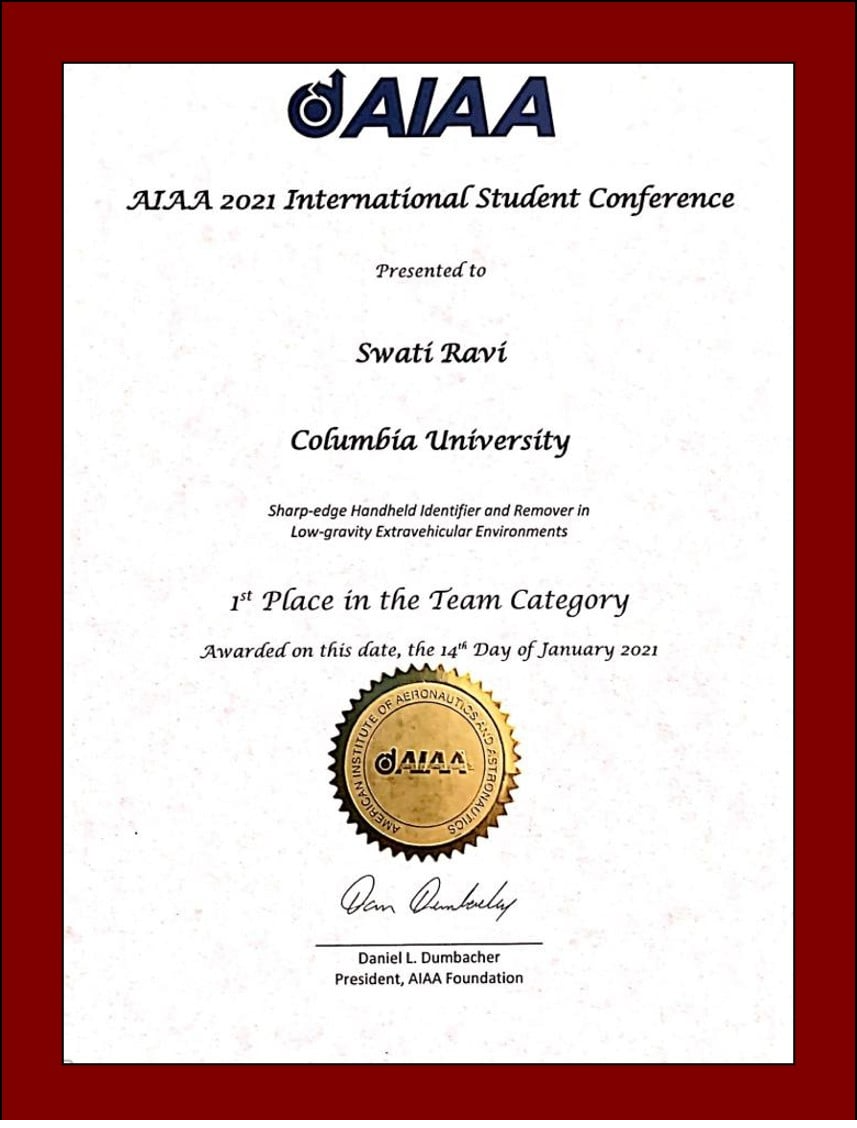
†*Dada, N, et al. (6 coauthors including Swati Ravi) “Sharp-edge Handheld Identifier and Remover in Low-gravity Extravehicular Environments” AIAA SciTech Forum, 2021. DOI: 10.2514/6.2021-0579
Details
AIAA Sci-Tech 2021 Conference Paper on sharp-edge detection and removal for astronaut safety aboard the International Space Station-developed at Columbia University and tested at NASA’s Neutral Buoyancy Laboratory. Won 1st place student team presentation at Sci-Tech 2021.
Talks
* indicates invited
Ravi, Swati, Marshall, Herman, Ng, Mason “Probing Time-Resolved Polarization Angle Variability in Blazar Jets Using Bayesian Nested Sampling” HEAD 22 Meeting 15, September 2025, St. Louis, MO.
Details
Contributed talk at the 22nd meeting of the AAS High Energy Astrophysics Division (HEAD) in which I describe polarization angle time-variability found from re-analyzing archival Imaging X-ray Polarimetry Explorer (IXPE) data of the blazars Mrk 421 and BL Lac using my nested sampling polarization analysis tool QUEEN-BEE, and the physical implications of these findings on the structure and composition of relativistic jets (St. Louis, MO).
Ravi, Swati, Ng, Mason, Marshall, Herman, Gnarini, Andrea “Probing Variability in X-ray Polarization with Bayesian Nested Sampling” Harvard ITC Luncheon, 25, September, 2025, Cambridge, MA.
Details
Harvard ITC Luncheon seminar in which I discuss the results of my Bayesian nested sampling analysis code QUEEN-BEE applied to telescope observations using the Imaging X-ray Polarimetry Explorer (IXPE) of the neutron star X-ray binary GX 13+1. I elucidate newfound short-term variability in the system and introduce the first polarimetric constraints on the system’s coronal geometry (Cambridge, MA).
*Ravi, Swati “Tracing Polarization Angle Evolution in Accreting Systems with IXPE using Bayesian Nested Sampling” INAF-IAPS seminar, 03, September 2025. Rome, Italy
Details
Invited seminar in which I describe the applications of my work studying polarization angle time-variability using my Bayesian nested sampling code QUEEN-BEE in a variety of Imaging X-ray Polarimetry Explorer (IXPE) telescope observations of compact systems including neutron star X-ray binaries, blazars, and accreting white dwarfs. (Rome, Italy).
Ravi, Swati, Marshall, Herman “Probing Time-Resolved Polarization Angle Variability in Blazar Jets Using Bayesian Nested Sampling” Extragalactic jets at all scales, 25, August 2025. Heraklion, Crete
Details
Contributed talk in which I describe polarization angle time-variability found from re-analyzing archival data from the Imaging X-ray Polarimetry Explorer (IXPE) of the blazars Mrk 421 and BL Lac using my nested sampling polarization analysis tool QUEEN-BEE, and the physical implications of these findings on the structure and composition of relativistic jets. (Heraklion, Crete).
Ravi, Swati, Marshall, Herman, Heine, Sarah, Garner, Alan, McNeil, Sean, Schulz, Norbert, Heilmann, Ralf, Guenther, Moritz, Juneau, Jill, LaMarr, Beverly, Metivier, Ace, Kelly, Ruth, Drake, Leonardo, Bongiorno, Stephen, Gullikson, Eric “Progress on the Rocket Experiment Demonstration of a Soft X-ray Polarimeter (REDSoX)” AAS 246 Summer Meeting, 10, June, 2025. Anchorage, AK.
Details
AAS contributed talk in which I introduced the NASA sounding rocket mission REDSoX which will perform the first X-ray spectropolarimetric measurements below 1 keV. I overviewed progress made toward optics shell replication, grating efficiency testing, and detector engineering model testing, and introduced the proposed NASA Pioneer orbital successor to REDSoX—GOSoX. (Anchorage, Alaska).
Ravi, Swati, Ng, Mason, Marshall, Herman “Unbinned Maximum Likelihood Estimation of Polarization Angle Rotation in GX 13+1” Frontiers in X-ray Polarimetry, 07, April, 2025. L’Aquila, Italy. (Poster)
Ravi, Swati, Ng Mason, Marshall, Herman “Determining the Polarization Angle Rotation in GX 13+1 Using Bayesian Nested Sampling” AAS 245 Winter Meeting, 14, January, 2025. National Harbor, MD.
Details
AAS contributed talk in which I showed the results of applying a new method of maximum likelihood estimation to Imaging Polarimetry Explorer (IXPE) telescope polarimetry data from the Neutron star-low-mass X-ray binary GX 13+1. My results using this method agree with the standard method (PCUBE), and I show that this method can produce an agreeing polarization angle rotation rate to that found using PCUBE without the need for manually binning the data. This method also utilizes a Bayesian nested sampling appraoch which allows for more physically-motivated results. (National Harbor, Maryland).
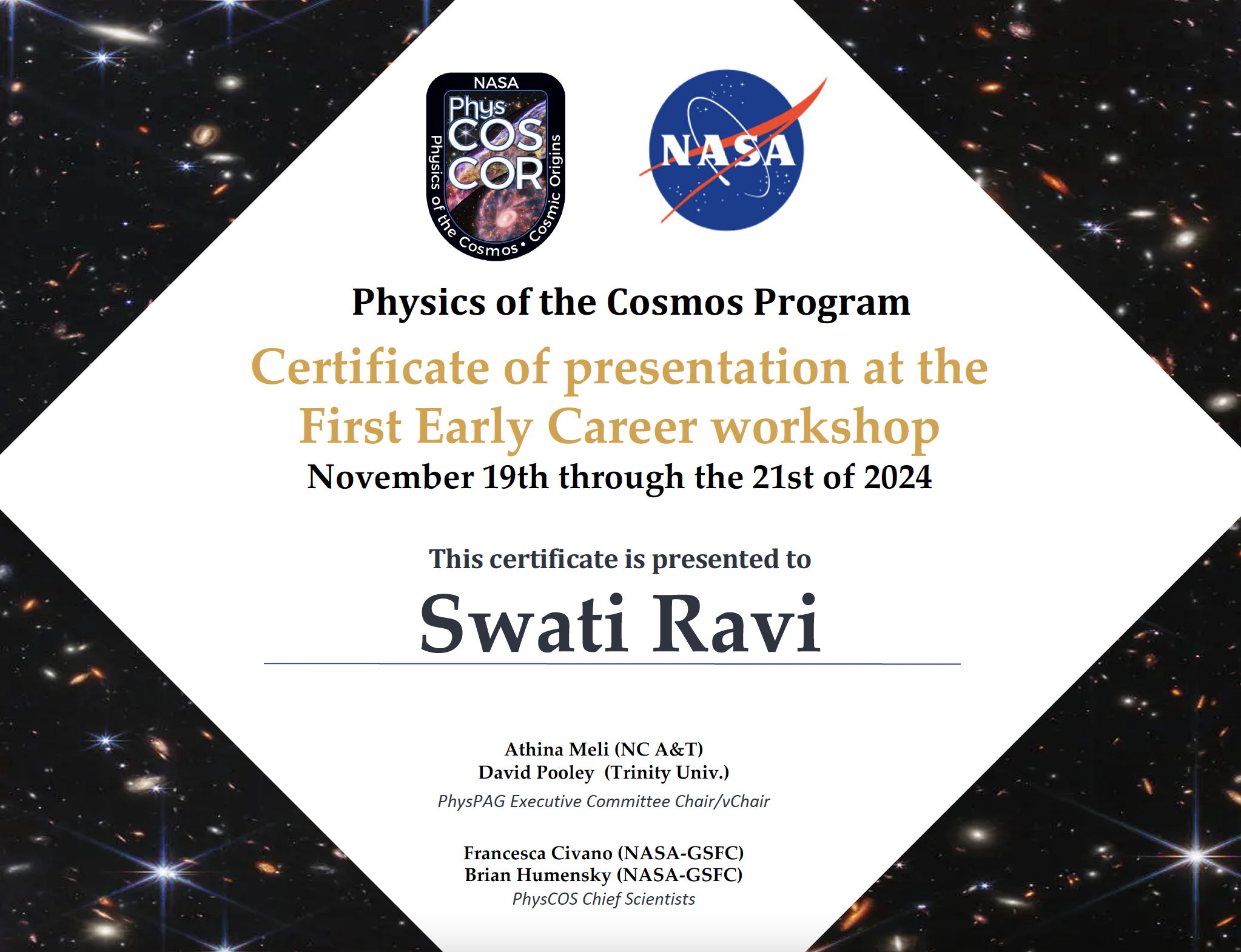
Ravi, Swati “Engineering at the Extremes: NASA Technology Development Across 30 Orders of Magnitude” NASA Physics of the Cosmos Early Career Workshop, 20, November, 2024. Virtual.
Details
Virtual contributed talk given at NASA’s Physics of the Cosmos Early Career Workshop describing two NASA technology development projects I’ve been involved with—Characterizing Antibiotic Resistance in Microgravity Environments (CARMEn) and the Rocket Experiment Demonstration of a Soft X-ray Polarimeter (REDSoX).
Abstract: The Rocket Experiment Demonstration of a Soft X-ray Polarimeter (REDSoX) is a NASA sounding rocket mission conducting X-ray spectropolarimetry below 1 keV for targets such as the blazar Mrk 421. The instrument is scheduled for launch in late 2027 and will utilize a focusing Wolter I optic, Critical Angle Transmission (CAT) gratings, and laterally graded multilayer mirrors at Brewster’s angle to perform spectropolarimetry in the energy range of 0.2–0.4 keV. In this talk I discussed my current work on the REDSoX mission and related it to my previous work developing the NASA mission Characterizing Antibiotic Resistance in Microgravity Environments (CARMEn), a 30-day ISS mission studying bacterial antibiotic resistance in space, to highlight similarities and differences in the technology development process for space-based NASA missions across different size scales.
Ravi, Swati, Ng, Mason, Marshall, Herman “Unbinned Maximum Likelihood Estimation of Polarization Angle Rotation in GX 13+1” IXPO, 17, September, 2024. Huntsville, AL. (Poster)
Ravi, Swati, Ng, Mason, Marshall, Herman “Unbinned Maximum Likelihood Estimation of Polarization Angle Rotation in GX 13+1” COSPAR Scientific Assembly, 19, July, 2024. Busan, South Korea.
Details
View Abstract, View Description
COSPAR contributed talk in which I showed the results of applying a new method of maximum likelihood estimation to Imaging Polarimetry Explorer (IXPE) telescope polarimetry data from the Neutron star-low-mass X-ray binary GX 13+1. My results using this method agree with the standard method (PCUBE), and I show that this method can produce an agreeing polarization angle rotation rate to that found using PCUBE without the need for manually binning the data. This method also utilizes a Bayesian approach which allows for more physically-motivated results. (Busan, South Korea).
*Ravi, Swati, Garner, Alan, et. al. “Progress on the rocket experiment demonstration of a soft x-ray polarimeter (REDSoX)” COSPAR Scientific Assembly, 17, July, 2024. Busan, South Korea.
Details
Invited COSPAR talk on behalf of Alan Garner overviewing the progress made on the Rocket Experiment Demonstration of a Soft X-ray Polarimeter (REDSoX). I overview the instrument design including a multilayer mirror and custom-manufactured diffraction gratings and present successful shake-test results of the grating. (Busan, South Korea).
*“Characterizing Antibiotic Resistance in Microgravity Environments” NTRS – NASA Technical Reports Server, NASA, 2021. Doc ID: 20210025730. Cape Canaveral, FL.
Details
Pre-launch oral presentation at Kennedy Space Center visitor center describing the science goals and engineering design of the CARMEn mission flown to the ISS on SpaceX CRS-24.
Ravi, Swati “Sharp-Edge Detection and Removal on ISS Handrails” Next-Generation Suborbital Researchers Conference, 02, March, 2020. Broomfield, CO. (Poster)
Details
Poster Presentation for NSRC 2020 (Broomfield, CO) on sharp-edge detection and removal for astronaut safety aboard the International Space Station-developed at Columbia University and tested at NASA’s Neutral Buoyancy Laboratory.
Ravi, Swati, Ness, Melissa. “Data-driven Modeling of MaNGA Galaxies with Milky Way Spectra” Large Synoptic Survey Telescope (LSST) Workshop, 13, August, 2019. Tucson, AZ (Poster)
Details
Poster presentation at Large Synoptic Survey Telescope (LSST) Workshop (Tucson, AZ) on modeling distant galaxies with near-field spectra of Milky Way stars in the SDSS MaStar catalog.
“Using an Adjustable Parallel-Plate Capacitor to Verify the Theoretical Equivalence of Stacked Dielectrics and Capacitors in Series” SMU QuarkNet, 20, September, 2017. Dallas, TX. (Poster)
Details
“Comparing Measured Values from a Fixed Parallel Plate Capacitor Instrument and Theoretical Values of Capacitors in Parallel” SMU QuarkNet, 20, September, 2017. Dallas, TX. (Poster)
 Swati
Swati 